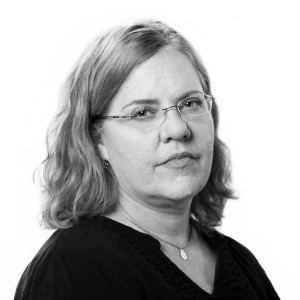
Jennifer LaFleur teaches at U.C. Berkeley’s Graduate School of Journalism where she also works with the school’s Investigative Reporting Program.
LaFleur was formerly a senior editor at the Center for Public Integrity, an independent, nonpartisan and nonprofit news organization focused on investigating the root causes of inequality. She joined CPI from the Investigative Reporting Workshop at American University, where she was data journalist in residence. At IRW, LaFleur helped launch The Accountability Project, a public data search tool with more than 1.8 billion government records. LaFleur previously served as a senior editor for Reveal from The Center for Investigative Reporting, where she managed an award-winning team of data journalists, investigative reporters and fellows.
Throughout her career, open-records have been the core of LaFleur’s work. She has written extensively about FOIA and open records, including starting public records columns at the Dallas Morning News and the San Jose Mercury News. She was 2002/2003 fellow for the Reporters Committee for Freedom of the Press where she produced a guide on Access to Electronic Records and The Lost Stories, a white paper about the impact on journalism of post-9/11 closures of government information. She also contributed to HomeFront Confidential, a series of reports about what happened to the public’s right to know post-9/11.
LaFleur’s journalism career includes serving as the director of data journalism at ProPublica, an independent, nonprofit investigative newsroom, where she investigated the federal pardon system. prescribing patterns under Medicare Part D and disparities in the benefits for Alaska Native Corporations. She held similar roles at The Dallas Morning News and other newspapers. Her work on the Morning News’ “Striking Differences” revealing racial bias in jury selection has been cited widely. She is a former training director for Investigative Reporters & Editors, a nonprofit trade organization dedicated to improving the quality of investigative reporting, and previously served on IRE’s board of directors. She is a board member of the Fund for Investigative Journalism, an independent grant-making organization, and is a member of the advisory board for the National Center for Disability and Journalism, a nonprofit, educational organization that provides training to improve coverage of disability in the media.
(Updated April 2025)
Class of 2006
- Andrew Alexander
- Gary Bass
- Thomas S. Blanton
- Danielle Brian
- David Burnham
- Hodding Carter III
- Tom Curley
- Tom Devine
- Kevin Goldberg
- Morton H. Halperin
- Charles W. Hinkle
- Kathleen A. Kirby
- Susan B. Long
- Robert D. Lystad
- John E. Pike
- Ronald L. Plesser
- Russ Roberts
- A. Bryan Siebert
- David Sobel
- Thomas M. Susman
- Mark Tapscott
Class of 1996
- Samuel J. Archibald
- Scott Armstrong
- U.S. Sen. Hank Brown
- Harold L. Cross
- Lucy A. Dalglish
- Earl English
- U.S. Rep. Dante Fascell
- Paul Fisher
- William H. Hornby
- Jane E. Kirtley
- Jack C. Landau
- U.S. Sen. Patrick J. Leahy
- U.S. Sen. Edward Long
- Paul K. McMasters
- U.S. Rep. John E. Moss
- J. Edward Murray
- Virgil M. Newton Jr.
- Jean H. Otto
- James S. Pope
- Harold C. Relyea
- Richard M. Schmidt Jr.
- Sheryl L. Walter
- Bruce W. Sanford
- J. Russell Wiggins