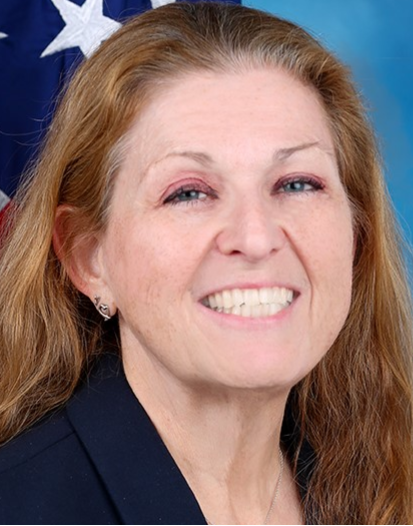
Kirsten B. Mitchell has made two careers out of cultivating curiosity and asking questions — first as a journalist and now as an advocate for freedom of information and public access. Kirsten leads FOIA compliance efforts at the federal FOIA Ombuds office — the Office of Government Information Services (OGIS) at the National Archives — and manages the federal FOIA Advisory Committee as its Designated Federal Officer. Kirsten’s work has spanned both of OGIS’s statutory functions — providing mediation services and reviewing FOIA policies, procedures and compliance. She built OGIS’s compliance program from the ground up, focusing on identifying broad systemic issues ripe for attention and advocating for a better FOIA process for all.

A longtime journalist before joining government service, Kirsten spent the bulk of her journalism career in North Carolina and Washington, D.C., at New York Times-owned regional newspapers and later at the Reporters Committee for Freedom of the Press and the Sunshine in Government Initiative. As a journalist, Kirsten frequently used state and federal records as well as database analysis to shine a light on how government operates. Kirsten served on the Board of Directors of the American Society of Access Professionals (ASAP) for eight years, including as president (2019-2020), and as a fellow in the Excellence in Government leadership program at the Partnership for Public Service (2017-2018). In her free time, Kirsten serves on the board of the D.C. Open Government Coalition.

Kirsten is an alumna of Mary Washington College and American University where she earned her B.A. in English and her M.A. in journalism and public affairs, respectively. She holds a certificate in mediation from NVMS Conflict Resolution Center, an affiliate of George Mason University’s School for Peace and Conflict Resolution.


  • Michael Morisy is the co-founder and chief executive officer of MuckRock, a nonprofit organization dedicated to strengthening transparency and accountability through public records. Under his leadership, MuckRock has helped connect millions of requesters with training, request templates, and other practical resources to access government information at the local, state, and federal level. MuckRock also maintains an archive of tens of millions of pages of released records and supports more than 4,000 newsrooms through tools including DocumentCloud and FOIA Machine.

    Morisy has also contributed to the advancement of federal transparency policy through two terms of service on the federal FOIA Advisory Committee. He previously served as a digital technology editor at The Boston Globe and was a John S. Knight Journalism Fellow at Stanford University.

    He is a graduate of Cornell University and has served on the boards of the American Society of Access Professionals and the National Freedom of Information Coalition.


  • Ginger Quintero-McCall is a partner and co-founder of the Free Information Group (https://freeinformationgroup.com), a public interest law firm focused on affordable and accessible Freedom of Information Act litigation. She has worked as both a government public records attorney and an attorney for the requester community.  

    She previously worked at the Federal Emergency Management Agency, Federal Communications Commission, and U.S. Department of Labor.  Quintero-McCall also served as Oregon’s first Public Records Advocate, where she provided statewide training on public records laws and offered public records mediation services to requesters and government employees. 

    Prior to her work in government, she was the Associate Director of the Electronic Privacy Information Center (EPIC), a public interest research center, where she directed the Center’s Open Government Program and legal internship program. Quintero-McCall has twice served on the FOIA Federal Advisory Committee and has taught a course on the Law of Open Government at Georgetown University Law Center. She co-edited Litigation Under the Federal Government Laws 2010; has been published in the New York Times, the Oregonian, and the Bulwark; and has co-authored several friend-of-the-court briefs to the U.S. Supreme Court. 

    Quintero-McCall received her law degree from Cornell Law School and graduated magna cum laude from the University of Pittsburgh. 


  • Carol Rosenberg has been filing requests under the Freedom of Information Act since she returned to the United States in the mid 1990s after years of reporting in the Middle East.

    First for The Miami Herald and later for The New York Times, she has leveraged FOIA to unearth government records and contracts , FBI files, military investigations and historic photographs. Sometimes she has sued. Sometimes she has cajoled. Often, she has filed appeals for returns that took months, even years, and came too late or too redacted.

    “It is an important tool in a reporter’s toolbox that can sometimes yield information otherwise hidden from public view,” Rosenberg says. “It can be the tool of last resort. But it has served me well.”

    Her filings have produced solid information and meaningful results.

    In 2018, a FOIA request returned the employment application of a U.S. immigration court judge who had secretly sought the job while serving as an Air Force judge in a Guantanamo case. He had failed to disclose to the parties that he was seeking a post-military job from the same entity that had a role in prosecuting the case, the Justice Department.

    Defense lawyers for the prisoner were stunned by what they saw as a conflict of interest, which government lawyers had not disclosed to them. The lawyers appended the file and her article to an ongoing case, resulting in the U.S. Court of Appeals for the District of Columbia Circuit vacating two years of that judge’s rulings. That FOIA discovery reverberated throughout the Guantanamo court and in a military court-martial case. Now; military judges and their staff are bound to disclose their pursuits of other government jobs.

    One favorite – and surprising – return occurred during the coronavirus pandemic. While working from home, she opened a zip file from the National Archives and two-decade-old photos of prisoners in orange jumpsuits arriving at Guantanamo spilled out onto her computer screen. She was there that day, January 11, 2002, and had seen military photographers documenting the mission from a far, as a pool reporter.

    But the photos were hidden away until a series of FOIA requests and follow up phone calls  released them. The work then began on The Secret Pentagon Photos of the First Prisoners at Guantánamo Bay, an annotated study that fronted a Sunday edition of The New York Times. The project gave the public a new opportunity to explore an episode of U.S. history whose consequences are still felt today.


  • Daniel Schuman is the Executive Director and founder of the American Governance Institute, a non-profit organization focused on strengthening the institutions of American government.

    Daniel is deeply involved in efforts to strengthen our democracy, including strengthening mechanisms for federal governmental accountability, transparency, and reform; reforming Congress; providing appropriate checks on the Executive branch, including expanded transparency and accountability; modernizing government technology for improved responsiveness, accountability, and efficiency; professionalizing federal employees; improving government ethics processes; empowering civil society; and ensuring that the people’s voices can be heard.

    He is a nationally recognized expert on the federal government, known in particular for his expertise in government accountability and transparency, the appropriations process, Legislative branch operations, data and technology, and congressional rules and procedures.

    Daniel is the founder and editor of the First Branch Forecast, a weekly newsletter that covers government accountability and transparency, with a focus on Congress and its interactions with the Executive branch. He is responsible for the creation or improvement of many federal government transparency and accountability websites and created EveryCRSReport.com, containing 20,000 Congressional Research Service Reports.

    He is a co-founder of the Congressional Data Coalition, co-directs the Advisory Committee on Transparency, and coordinates the OpenGov Roundtable. Daniel is a senior fellow with the Data Foundation. He routinely testifies before Congress on government accountability, transparency, modernization, and operations, and his work has been covered by the New York Times, the Washington Post, NPR, Roll Call, Politico, FedScoop, Wired, The Hill, C-SPAN, Federal News Radio, and other news outlets.

    Daniel was named by Washingtonian Magazine in 2022 as one of Washington DC’s 500 most influential people. In 2013, he was named by FedScoop as one of the top 25 most influential people under 40 in gov and tech. Daniel lectures on congressional information for Data Skills for Congress, a certificate program at the Goldman School of Public Policy at UC Berkeley, and on a variety of topics for the International Law Institute. He is a former CodeX fellow at Stanford University.

    Daniel served as Chair of the inaugural Open Government Federal Advisory Committee from September 2024 to March 2025. He previously worked as governance director of the POPVOX Foundation, policy director at Demand Progress Action & Demand Progress Education Fund, and policy director for Citizens for Responsibility and Ethics in Washington. Daniel was policy counsel at the Sunlight Foundation and a legislative attorney with the Congressional Research Service. He graduated cum laude from Emory University School of Law, where he was a Ruth and Paul McLarty scholar. Daniel also worked at the Constitution Project, the American Constitution Society, the House of Representatives, and the Georgia Trial Lawyers Association.


  • Alina M. Semo has served as the Director of the Office of Government Information Services (OGIS), the federal Freedom of Information Act (FOIA) Ombuds, since December 2016. OGIS, a part of the National Archives and Records Administration, opened its doors in 2009 and is charged with providing mediation services to resolve disputes between FOIA requesters and federal agencies, improving compliance with the statute, educating its stakeholders, and improving the administration of FOIA across the federal government.

    Semo brings more than 35 years of experience in federal information law, litigation, and oversight to her role. Prior to becoming Director of OGIS, Semo served as Director of Litigation in NARA’s Office of General Counsel. Before joining NARA, she spent nearly fifteen years in the Office of the General Counsel at the Federal Bureau of Investigation, including over a decade as Chief of the FOIA Litigation Unit, a unit she helped create shortly after 9/11.

    Semo began her federal government career at the U.S. Department of Justice, Federal Programs Branch, Civil Division, where she served as a trial attorney and later as senior counsel. Prior to her federal service, Semo practiced law in Washington, D.C.

    As Director of OGIS, Semo has overseen the office’s dispute resolution, compliance review, and policy recommendation functions and has supported the consistent administration of FOIA in accordance with statute. As the FOIA Ombuds, Semo is known for her leadership in strengthening FOIA policy and compliance across federal agencies, and works regularly with agencies, requesters, public-interest organizations, and Congress to improve public access to government records.

    Semo received a Bachelor of Arts degree in Government and Politics from the University of Maryland, College Park, and a Juris Doctor degree from Georgetown University Law Center. She is a member of the District of Columbia and Maryland bars.


  • Jennifer LaFleur teaches at U.C. Berkeley’s Graduate School of Journalism where she also  works with the school’s Investigative Reporting Program.

    LaFleur was formerly a senior editor at the Center for Public Integrity, an independent, nonpartisan and nonprofit news organization focused on investigating the root causes of inequality. She joined CPI from the Investigative Reporting Workshop at American University, where she was data journalist in residence. At IRW, LaFleur helped launch The Accountability Project, a public data search tool with more than 1.8 billion government records.  LaFleur previously served as a senior editor for Reveal from The Center for Investigative Reporting, where she managed an award-winning team of data journalists, investigative reporters and fellows.

    Throughout her career, open-records have been the core of LaFleur’s work.  She has written extensively about FOIA and open records, including starting public records columns at the Dallas Morning News and the San Jose Mercury News. She was 2002/2003 fellow for the Reporters Committee for Freedom of the Press where she produced a guide on Access to Electronic Records and The Lost Stories, a white paper about the impact on journalism of post-9/11 closures of government information. She also contributed to HomeFront Confidential, a series of reports about what happened to the public’s right to know post-9/11.

    LaFleur’s journalism career includes serving as the director of data journalism at ProPublica, an independent, nonprofit investigative newsroom, where she investigated the federal pardon system. prescribing patterns under Medicare Part D and disparities in the benefits for Alaska Native Corporations. She held similar roles at The Dallas Morning News and other newspapers.  Her work on the Morning News’ “Striking Differences” revealing racial bias in jury selection has been cited widely. She is a former training director for Investigative Reporters & Editors, a nonprofit trade organization dedicated to improving the quality of investigative reporting, and previously served on IRE’s board of directors. She is a board member of the Fund for Investigative Journalism, an independent grant-making organization, and is a member of the advisory board for the National Center for Disability and Journalism, a nonprofit, educational organization that provides training to improve coverage of disability in the media. 

    (Updated April 2025)


  • Rick Blum is the founder and CEO of Sixteenth Street Consulting LLC, which helps advocacy organizations expand and diversify support, create and sustain coalitions, and build winning strategies.

    Rick has organized numerous coalitions and initiatives to protect press freedom and promote open government. For over a decade, Rick coordinated News Media for Open Government, a coalition of major news media associations promoting open government policies and practices. He led the coalition (until 2017 known as the Sunshine in Government Initiative) in its work supporting enactment of the 2007 amendments to the Freedom of Information Act (FOIA) and the FOIA Improvement Act of 2016. His work defending against unnecessary, overbroad or self-serving secrecy lead him to any number of topics, such as tracking space junk, the farm bill, and high-speed rail. He also helped explain to Congress how the news media keep the public informed based on unauthorized disclosures of classified information (“leaks”), addressing concerns about WikiLeaks and successfully pushing back against anti-leaks proposals in the Intelligence Authorization Act for 2013.

    Blum testified numerous times before Congress on FOIA implementation and exemptions, science and disclosure, and federal legislation to shield journalists from revealing confidential sources. He helped numerous experts and news media representatives prepare for appearances before Congress on press freedom and open government topics. 

    Blum was the founding director of OpenTheGovernment.org, a broad coalition of journalists, labor, and free-speech and environmental advocates. Rick served as the first policy director of the Reporters Committee for Freedom of the Press, where he helped the organization define its policy work on a wide range of topics affecting newsgathering and transparency.

    He holds a master’s degree from Indiana University, where his studies focused on democratization efforts in Russia, and a bachelor’s degree from the University of California, Berkeley. 

    (Updated May 2025)


  • Debra Gersh Hernandez is director of communications for the Reporters Committee for Freedom of the Press and is a coordinator of the national Sunshine Week open government initiative, in partnership with the American Society of News Editors. Previously, she was the first full-time Sunshine Week coordinator for ASNE. She has served in various communications roles for the Newspaper Association of America and the American Advertising Federation.

    For many years, Gersh Hernandez was a reporter and editor for Editor & Publisher magazine, first in New York City and later in Washington, D.C. She has worked asa consultant/freelancer for various organizations, including the Open GovernmentPartnership, National Judicial Education Program, the Student Press Law Center, andthe National Newspaper Association.

    A graduate of the S.I. Newhouse School of Communications at Syracuse University,Gersh Hernandez is currently an alumni board representative to The Daily Orange, theindependent student newspaper at Syracuse.


  • Jameel Jaffer is the inaugural director of the Knight First Amendment Institute at Columbia University, which was established by Columbia University and the Knight Foundation to promote the freedoms of speech and the press in the digital age. Since its inception in 2016, the Institute has taken on major litigation and research projects relating to free speech online, social media, artificial intelligence, new surveillance technology, algorithmic amplification, wartime censorship, the rights of whistleblowers, and government secrecy.

    Between 2002 and 2016, Jaffer was a lawyer for the American Civil Liberties Union, ultimately overseeing all of the organization’s work on free speech, privacy, technology, national security, and international human rights. He led or co-led litigation teams that compelled the Bush administration to disclose the “torture memos,” compelled the Obama administration to disclose the “drone memos,” and forced the National Security Agency to abandon its dragnet surveillance of Americans’ call records. He played a major part in the ACLU’s decision to take on the representation of Edward Snowden. The New York Times described one of his transparency cases as “among the most successful in the history of public disclosure.”

    Jaffer’s recent writing has appeared in the New York Times, The New Yorker, the New York Review of Books, Le Monde, the Guardian, and Foreign Affairs. He is an executive editor of Just Security, a national security blog, and his book, The Drone Memos, was one of the Guardian’s “Best Books of 2016.” He was named to Foreign Policy’s “Top 100 Global Thinkers” list in 2012, received the Vox Libera award from Canadian Journalists for Free Expression in 2015, and was inducted into the Newseum’s Freedom of Information “Hall of Fame” in 2016. In recent years he has delivered the inaugural Peter Zenger Lecture at Columbia Journalism School; the Or’ Emet Lecture at York University’s Osgoode Hall Law School; the Eva Holtby Lecture on Contemporary Culture at the Royal Ontario Museum; and the Salant Lecture on Freedom of the Press at the Harvard Kennedy School’s Shorenstein Center. He was also the honoree at the Columbia Law Review’s annual banquet in 2015 and the Harvard Law Review’s annual banquet in 2022.

    Jaffer is a graduate of Williams College, Cambridge University, and Harvard Law School, where he was an editor of the Harvard Law Review. He served as a law clerk to Honorable Amalya L. Kearse of the U.S. Court of Appeals for the Second Circuit, and then to Right Honorable Beverley McLachlin, Chief Justice of Canada.